
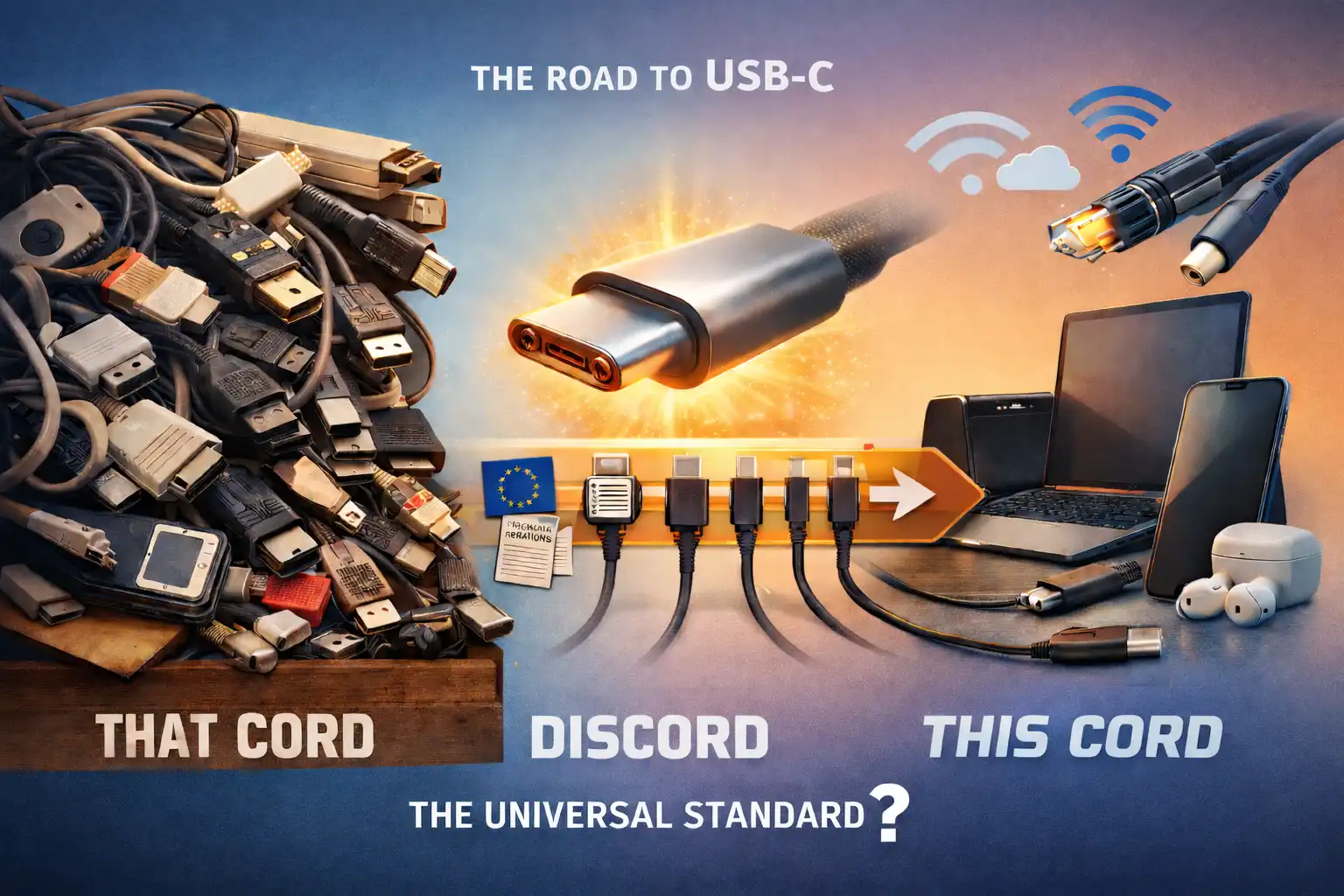
That Cord, Discord, and This Cord
Generations, Dongles, and the Long Road to USB-C
The Junk Drawer Tells the Story
Open the average junk drawer, and you’ll find a fossil record of modern technology: tangled cords from forgotten phones, chargers that fit nothing you still own, and mysterious adapters whose purposes were lost sometime around 2012.
For younger generations, cables are interchangeable utilities. For older ones, they’re artifacts—each tied to a specific device, era, and frustration.
That disconnect isn’t just about nostalgia or learning curves. It’s about how physical standards evolve faster than human habits. And nowhere is that more obvious than in the long, messy history of cables.
So, the real question in 2026 is simple but loaded:
Have we finally landed on USB-C as the universal standard, or is this just another temporary truce in the war of connectors?
The Cable Problem Is a Generational Problem
Stability vs. Constant Change
For Baby Boomers and Gen X:
- Cables were stable
- Stereo wires lasted decades
- A printer cable from the ’90s still worked well into the 2010s
- Devices aged, but accessories endured
For Millennials:
- The transition generation
- Lived through:
- USB-A
- USB-B
- Mini USB
- Micro USB
- HDMI variants
- Serial
- VGA
- DisplayPort
- Apple’s 30-pin connector
- FireWire
- Lightning
- Each promised simplicity, but delivered more clutter
For Gen Z and Gen Alpha:
- Grew up in the replace-everything era
- Devices refresh every few years
- Accessories are assumed to change with them
- Cables feel disposable
- Wireless charging, Bluetooth, and the cloud hide the infrastructure—but don’t eliminate it
The core divide:
- Older generations expect stability
- Younger generations expect change—and aren’t surprised when standards shift again
A Brief (and Painful) History of “Universal” Cables
USB was supposed to solve this.
Introduced in 1996, the Universal Serial Bus aimed to replace a chaotic mix of ports with a single connector for power and data.
And it worked… uh, mostly.
What Happened Next
- Early USB-A and USB-B:
- Reliable
- Bulky
- Mini USB and Micro USB:
- Smaller
- Cheaper
- More fragile
- Known for worn-out ports and finicky connections
- Proprietary detours:
- FireWire
- Apple’s Lightning
- Offered speed or slimness
- Sacrificed compatibility
- Added to the junk drawer
Each shift solved a technical problem of its time—but created social friction:
- Families argued
- Retail workers explained
- Adapters multiplied
Why USB-C Is Different
USB-C, introduced in the mid-2010s, feels different because it consolidates.
Technically, It Checks Nearly Every Box:
- Reversible
- Scales from earbuds to laptops
- Carries power, data, and video
- Supports up to 240W with USB Power Delivery
But the real breakthrough wasn’t just engineering.
It was politics.
The EU Effect
As of December 28, 2024, the European Union requires USB-C on most rechargeable consumer electronics, with laptops following in April 2026.
Even longtime holdouts—most notably Apple—were forced to abandon proprietary ports.
For the first time:
- A global hardware standard wasn’t driven by convenience
- It wasn’t driven by market forces
- It was driven by regulation
That alone makes USB-C feel less like a phase—and more like an inflection point.
Is USB-C the End of the Story?
Probably not.
But it is a plateau.
What’s Changing Now
The connector shape isn’t evolving—what it can do is.
USB-C already supports:
- USB4
- Thunderbolt
- DisplayPort
- HDMI tunneling
Future improvements will focus on:
- Speed
- Efficiency
- Smarter power negotiation
All without changing the port.
Competing Pressures
At the same time:
- Wireless tech is reducing reliance on cables
- Specialized optical connectors are emerging
Any true successor would require a fundamental shift in how devices exchange power and data—not just faster specs.
The Real Disconnect Isn’t Technical
It’s human.
- Older generations ask:
“Will this still work in ten years?” - Younger generations shrug and say:
“If not, I’ll replace it.”
USB-C doesn’t erase that tension—but it finally reduces it.
A Rare Moment of Alignment
For the first time in decades:
- Manufacturers
- Regulators
- Users
…are aligned around a single physical interface.
It may not last forever.
But it’s the closest we’ve come to peace.
The Bottom Line
- Our phones charge more easily
- Our devices talk to each other faster
- And maybe—just maybe—the junk drawer is finally starting to shrink
If you like this post: That Cord, Discord, and This Cord, keep following us for more tech related articles.