
ALL‑OUT OF AOL (LOL)
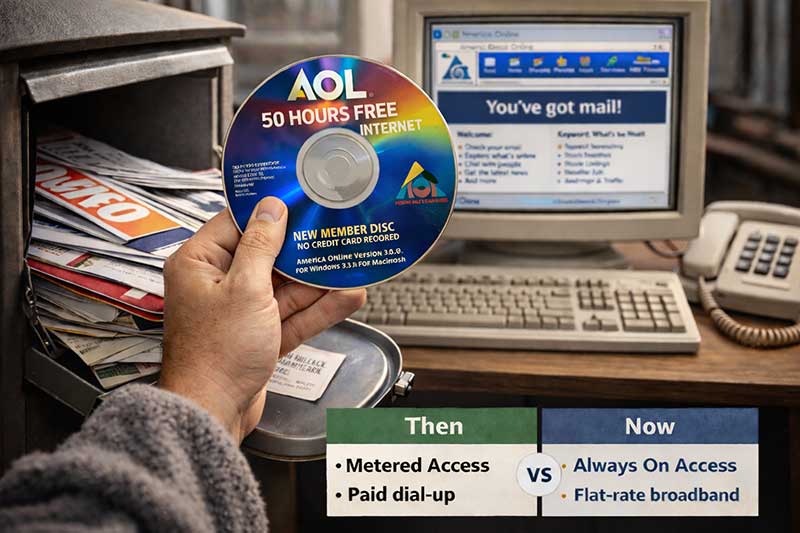 Picture it. It’s the mid-90’s. You open your metal mailbox—still searing from the afternoon sun—and sift through junk mail in your bathrobe and bunny slippers. Fluttering store flyers. A random magazine. Credit card offers you never asked for. A utility bill.
Then you spot it.
A rainbow‑colored disc tucked into the pile like a secret invitation:
“50 hours of Free Access to America Online.”
What once served as a short‑term skeleton key to the internet is now a cultural relic.
Today, the idea of timed internet access feels almost laughable in an era where information can be summoned instantly—even while sitting on a porcelain throne.
But those shiny AOL discs weren’t just clutter.
They were gateways.
When AOL Was the Internet
Before Wi‑Fi. Before broadband. Before smartphones. For millions of households, America Online wasn’t just an internet provider—it was the internet.
AOL succeeded not because it was fast (it wasn’t), or because it was powerful (it wasn’t). But because it made something intimidating feel approachable. Installing AOL didn’t require technical knowledge. You didn’t need to configure settings or speak to the modem. You popped in the disc, followed a few prompts, and waited through the now‑iconic symphony of dial‑up noises.
That infernal, nightmarish screech the computer made wasn’t just sound—it was…anticipation.
You weren’t casually online…you were logging on.
How the AOL Disc Actually Worked
Those free‑trial CDs were more deliberate than people remember.
AOL flooded mailboxes, magazines, grocery stores, video rental shops….even cereal boxes—anywhere people might pause long enough to notice a shiny disc. Or rather, be forced to notice. The strategy was simple: make sure everyone had access, whether they asked for it or not.
The discs installed AOL’s proprietary software and credited the user with a limited number of free minutes or hours. Every session counted. Each connection chipped away at the balance. Tick tock.
When you clicked “Connect,” your computer dialed a local access number over your home phone line. However, while you were connected:
- The phone line was occupied
- Pages loaded slowly
- Images appeared line by line
- And time was always ticking
Once your free minutes ran out, access stopped—unless you subscribed.
Internet access wasn’t assumed. It was intentional.
Why This Model Made Sense
In the mid‑1990s, the internet was unfamiliar, even suspicious. Many people had no idea what it was or why they needed it. AOL didn’t try to explain the internet—they let people experience it.
The free‑minute model lowered the barrier. It turned curiosity into habit. Habit into reliance. And reliance on paid subscriptions.
It worked because it matched the moment.
From Metered Minutes to Always‑On Expectations
As broadband expanded in the early 2000s, everything changed.
Internet access shifted from:
- Dial‑up to high‑speed
- Per‑minute sessions to flat monthly pricing
- Occasional use to constant availability
The internet moved from novelty to necessity. Email became instant. Businesses relied on real‑time systems. Streaming replaced downloading. Being offline became the exception—not the norm.
The limitations we once tolerated quietly became unacceptable.
Why People Are Nervous Today
Fast‑forward to the present, and a similar anxiety has resurfaced.
Modern debates about internet regulation—especially around Net Neutrality—tap into a familiar fear: What if access becomes controlled again?
Not through minutes this time, but through:
- Speed tiers
- Paid prioritization
- Invisible throttling
- Unequal access
The concern isn’t that the internet will disappear. It’s that it could become fragmented—fast for some, limited for others.
The Uncomfortable Parallel
Then | Now |
Metered minutes | Tiered speeds & prioritization |
One provider controlled access | ISPs manage traffic flow |
Paying unlocked more time | Paying may unlock performance |
Limits were obvious | Limits can be invisible |
In the AOL era, you knew when access ended.
Today, the fear is not knowing why access feels different.
The Lesson AOL Left Behind
AOL reminds us that technology always moves toward less friction.
What feels revolutionary at first eventually feels restrictive. Users tolerate limits early on—until the experience becomes essential. Once that happens, any hint of regression sparks resistance.
The internet didn’t just evolve technically. It also evolved…….psychologically.
Why This Matters for Businesses
Modern businesses operate on the assumption of:
- Always‑on connectivity
- Real‑time systems
- Instant communication
- Seamless customer experience
Downtime isn’t merely a passing inconvenience anymore. Due to our reliance on the internet today, it’s quite disruptive to say the least. But that expectation didn’t appear overnight. It was built over decades, beginning with a rainbow disc and 60 free minutes.
Final Thoughts on ALL‑OUT OF AOL (LOL)
The irony of AOL is that limited access helped open the door to the internet, while teaching us exactly why limitations feel so uncomfortable once freedom becomes normal.
Once you stop thinking about how you connect, counting minutes feels impossible.
And that may be the most lasting legacy of all.